





Between Design and Making: architecture and craftsmanship 1630-1760

Between Design and Making: architecture and craftsmanship 1630-1760, edited by Andrew Tierney and Melanie Heyes, with foreword by Christine Casey, UCL Press, 2024, 368pp, 162 illustrations.
Architecture has always been an intensely collaborative practice, however much architects like to view themselves at its core. Between Design and Making explores these elaborate and intense interactions through a collection of 10 extended essays, examining the building practices of the later 17th and the 18th centuries.
In July 1779 a Mrs Montague wrote an engaging letter to the Duchess of Portland which outlines these complex collaborations perhaps as well as anyone ever has: ‘I was greatly mortified that it was not in my power to wait on Mrs Delaney… but I was detained at my new house by my architect. He came at the head of a regiment of artificers. The bricklayer talked about the alterations to be made to a wall; the stonemason was eloquent about the coping of the same wall; the carpenter thought the internal fitting up of the house not less important; then came the painter who is painting my ceilings according to the latest fashion. The morning and my spirits were quite exhausted before these important persons had the goodness to release me.’
Andrew Tierney and Melanie Hayes are both research fellows at Trinity College, Dublin. A number of these essays on architectural practice and representation maintain a strong Irish content. British readers should be in no way discouraged by this, as building practice had the strongest parallels on either side of the Irish Sea throughout the period in question.
The individual essays range widely from construction practices at Oxford Colleges in the 18th century to those advanced by Richard Castle at Trinity, Dublin, in the 1730s and 40s. Castle emerges as an intriguing figure in another essay by Nele Luttman, exploring his origins and early career in Saxony early in the 18th century. Particularly sumptuous photographs illustrate Lydia Hamlett’s exploration of classical mural painting (mostly in British houses) between 1630 and 1730. Almost as striking are the mouldings, profiles and enrichments illustrated by Edward McParland in photographs taken from Dublin, across Britain, through Rome to St Petersburg. If you think yourself well-versed with classical mouldings, you may yet find the odd one here which could be unfamiliar!
Almost any conservation practitioner who has been involved in work to a Georgian building will recognise insights by Mairtin D’Alton and Flora O’Mahony regarding a programme of repairs to Damer House in the centre of Roscrea, County Tipperary. The building was twice saved, first by the Irish Georgian Society, then later the Old Roscrea Society, and it is now secure in Irish State ownership.
Alistair Rowan observes instances when 18th-century tradesmen were permitted slightly too free a hand with elaborate external and internal embellishments, with occasionally over-exuberant results.
It is an uncomfortable truth that 18th-century architecture in Ireland was associated rather too closely with the Anglo- Irish Ascendency for most of the turbulent 20th century, with profoundly unfortunate consequences for building survival rates. We may hope that this collection of essays, alongside the longstanding work of the Irish Georgian Society and the emergence of recent websites such as Historic Houses of Ireland, may signal that a precious and distinctive architectural heritage comes into fair regard as the current century progresses and the manifold wrongs of the past gradually recede.
This article originally appeared as ‘Collaborative practice’ in the Institute of Historic Building Conservation’s (IHBC’s) Context 183, published in March 2025. It was written by Michael Scammell, a conservation officer employed by the South Downs National Park Authority.
--Institute of Historic Building Conservation
Related articles on Designing Buildings Conservation.
IHBC NewsBlog
IHBC sponsors Gardens Trust event 23-4 Sept 2026
.jpeg)
'Learning from the Past, Shaping the Future’ takes place in Milton Keynes
Renovations to Frank Lloyd Wright's Fallingwater complete
.jpg)
World Heritage Preserved project opens house for tours again
Shakespeare Birthplace Trust places Hall's Croft on HAR Register
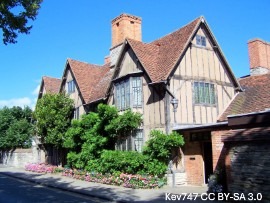
Stratford-upon-Avon home of Shakespeare's daughter is 'At Risk'
Lady Grange’s House repaired on St Kilda
.jpg)
National Trust for Scotland repairs stone cleit with link to famous island resident
Griff Rhys Jones on BBC Radio 4 Today programme
,_Green_Lane,_Derby.jpg)
The Victorian Society’s President unveiled its latest Top Ten Endangered Buildings 2026.
Need a MATE? Book your place now.
IHBC offers free webinars on applying for IHBC accreditation (Full & Associate).
UK Stained Glass Repository finds windows new homes
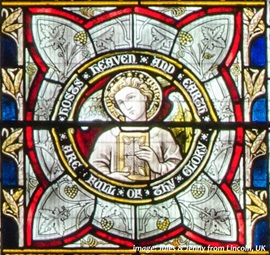
How are stained glass windows are rescued, stored and repurposed?
APPGEBE report sets high aims for quality
'Government must not sacrifice quality in drive to build 1.5m homes'
New measures protect Historic Shipwrecks from heritage crime

Underwater cultural heritage benefits from new HE guidance
How could the City of London skyline look in 6 years' time?

Visualisation shows approved planning applications as completed buildings
National Trust for Scotland calls for VAT cuts
Heritage neglect is encouraged by current policies
IHBC's 'Context' Issue 186 features Industrial Heritage
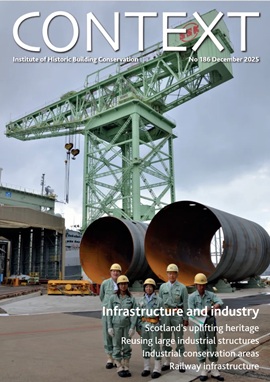
IHBC's members' journal reports on the challenges of conserving infrastructure
Book now for IHBC Annual School 2026
IHBC Annual School is taking place 18-20 June 2026 in Newcastle
RICHeS Research Infrastructure offers ‘Full Access Fund Call’
RICHeS offers a ‘Help’ webinar on 11 March
Latest IHBC Issue of Context features Roofing
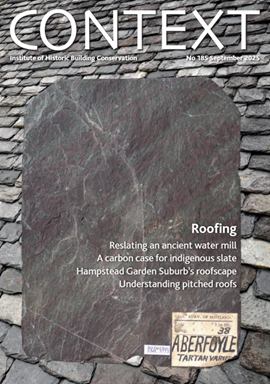
Articles range from slate to pitched roofs, and carbon impact to solar generation to roofscapes
Three reasons not to demolish Edinburgh’s Argyle House

Should 'Edinburgh's ugliest building' be saved?
IHBC’s 2025 Parliamentary Briefing...from Crafts in Crisis to Rubbish Retrofit
IHBC launches research-led ‘5 Commitments to Help Heritage Skills in Conservation’
How RDSAP 10.2 impacts EPC assessments in traditional buildings

Energy performance certificates (EPCs) tell us how energy efficient our buildings are, but the way these certificates are generated has changed.